Understanding Patient Responsibility (Deductibles, Copays & Coinsurance)
Last updated: July 27, 2026
Patient responsibility is one of the most important — and most misunderstood — parts of running a financially healthy ABA practice. It sits at the intersection of payer compliance, cash flow stability, and family experience, which means practice owners need a clear and consistent framework for how to handle it.
This guide is meant to give you that framework. You can customize it for your practice, add screenshots, or link to your billing partner’s tools.
Patient Responsibility Overview
It’s Required by Your Payer Contracts
Every commercial insurance plan uses some form of cost-sharing. Depending on the policy, families may owe:
Co-pays
Coinsurance
Deductible amounts
Alpaca's contracts with insurers require Alpaca (and by extension, your practice) to at least attempt to collect these amounts in full. Waiving, discounting, or ignoring patient responsibility without a compliant hardship process can be considered an impermissible “routine waiver of cost-share,” which can:
Violate your provider agreement
Trigger clawbacks
Jeopardize network participation
Signal potential fraud/waste/abuse concerns
Put simply: attempting to collect patient responsibility isn’t optional. It is part of maintaining your standing with payers and protecting your practice’s ability to serve families.
It’s Critical for Cash Flow
Even when insurance pays reliably, patient responsibility usually makes up 5–30 percent of the total allowed amount. In high-dosage ABA programs, this number is meaningful.
If you don’t collect patient responsibility:
Your margins shrink
Cash flow becomes unpredictable
You lose the ability to fund payroll, training, operations, and growth
Additionally, Alpaca only guarantees payment of the insurance-covered part of your contracted rate. So, if families don't pay their patient responsibility, that impacts both your practice and Alpaca. For a recap of Alpaca's payout model, please read this article.
How to Explain Patient Responsibility to Families
Families often think patient responsibility is arbitrary. Your goal is to re-frame it as:
A requirement dictated by their insurance plan
A fixed part of how benefits work
Something you collect only after the insurer decides the final amount
Keep it simple:
“We don’t set the amount you owe. We only bill what your insurance company tells us on the finalized Explanation of Benefits.”
Once parents understand that you’re passing through the exact EOB amount — not estimating, not marking it up, not making up charges — they tend to be much more comfortable with the process.
We've written a parent-facing guide to patient responsibility that is shared with parents during on-boarding and also available through their parent portal.
When Patient Responsibility Is Charged
Alpaca follows industry best practice, which is to never charge upfront and never charge based on estimates.
Alpaca bills families only after insurance finalizes the claim and sends an Explanation of Benefits (EOB) specifying:
What was billed
What insurance covered
The exact amount the family owes
This protects families from incorrect charges and keeps us all aligned with payer expectations.
How Alpaca Charges Patient Responsibility Is Charged
We've written a parent-facing guide to patient responsibility that is shared with parents during on-boarding and also available through their parent portal. This guide has screenshots that show you the parent-facing experience.
In summary:
Starting 12/3/2025, parents (who don't have Medicaid) are prompted to enter a card on file on the parent portal as part of on-boarding.
Parents registered before this date are notified about this new feature and will be prompted to fill in their card on file.
Parents will get a notification on Friday about their outstanding balance.
Parents' card on file will be charged on Sunday, before your practice's payout deadline for signed session notes and paid patient responsibility.
Financial Hardship Waivers
Why Hardship Waivers Exist
Even though payers require you to collect patient responsibility, they also allow you to reduce or waive it in limited circumstances — but only with a documented, individualized financial hardship determination.
This lets you support families without violating payer rules.
When Hardship Waivers Make Business Sense
If a family is in crisis, or if their deductible would create an unmanageable upfront expense in the first few months of care, offering a hardship waiver can be both:
Ethically important
Financially rational
ABA is a high-dosage service. A family who stays with you for nine to twelve months will typically generate far more revenue than the deductible amount you might reduce or waive.
A simple rule of thumb:
One year of retained services is almost always more valuable than insisting on full deductible collection from a family who may otherwise drop out.
How to tell Alpaca
If you have a hardship waiver, please notify Alpaca Health at support@alpacahealth.io, so we make sure families get invoiced but not billed. Even with a hardship waiver, Alpaca is still contractually obligated to bill families, even if we do not pursue collection.
How to Remain Fully Compliant
To stay compliant, you must avoid routine or automatic waivers. Payers only allow hardship reductions when you:
Evaluate hardship case-by-case
Apply consistent written criteria
Keep documentation showing why the waiver was appropriate
Never advertise waivers or use them as marketing
Never waive cost-share solely because a family complaints or requests it
Never waive to stay “competitive” with other providers
Your hardship file should include:
A completed hardship application from the family
A financial review or proof (pay stubs, unemployment letter, etc.)
Your internal determination
The approved waiver period and any limits
Renewal requirements (hardship waivers should expire, not run indefinitely)
If you are ever audited, this documentation protects your practice.
Working with Families While Staying Sustainable
You can support families without absorbing unsustainable losses. Best practice is to offer one of:
Payment plans (weekly or monthly)
Temporary partial waivers
Tiered reductions
Deferred start of collection until deductible is met
Re-evaluation every 60–90 days
Families feel cared for. Your practice stays financially stable. And you remain fully aligned with your payer contracts.
Tracking Patient Responsibility on Alpaca
How do I know much patient responsibility my families have?
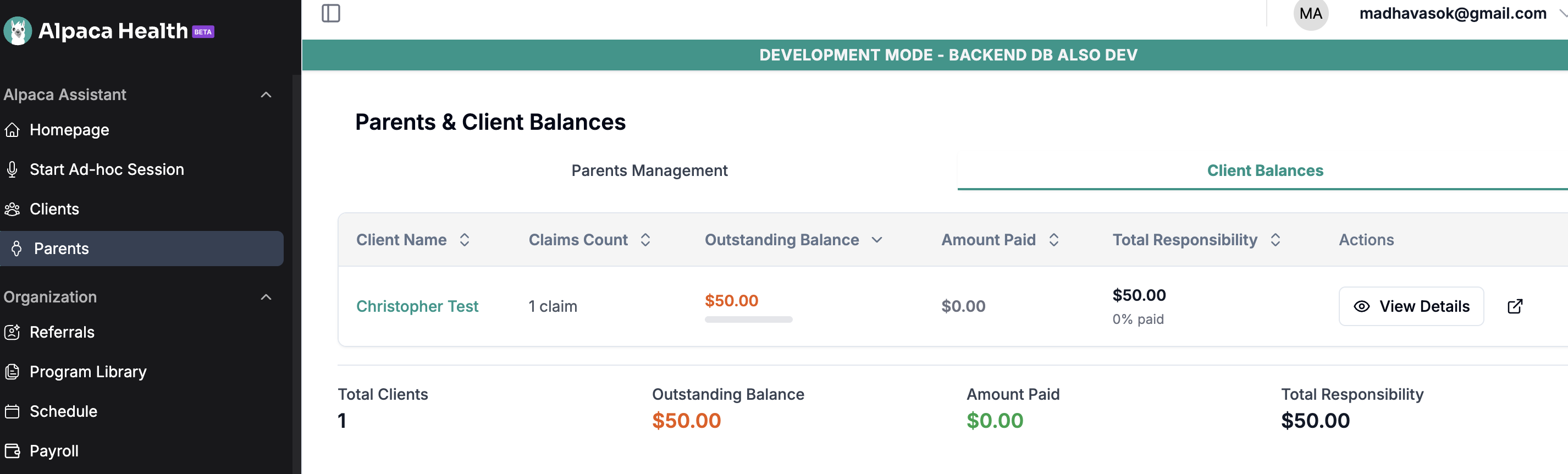
On the Parents tab of Alpaca, you can see a breakdown by patient of outstanding patient responsibility. In View Details, you see the details that are also available to the patient on their portal as well.
A parent is having log-in issues.
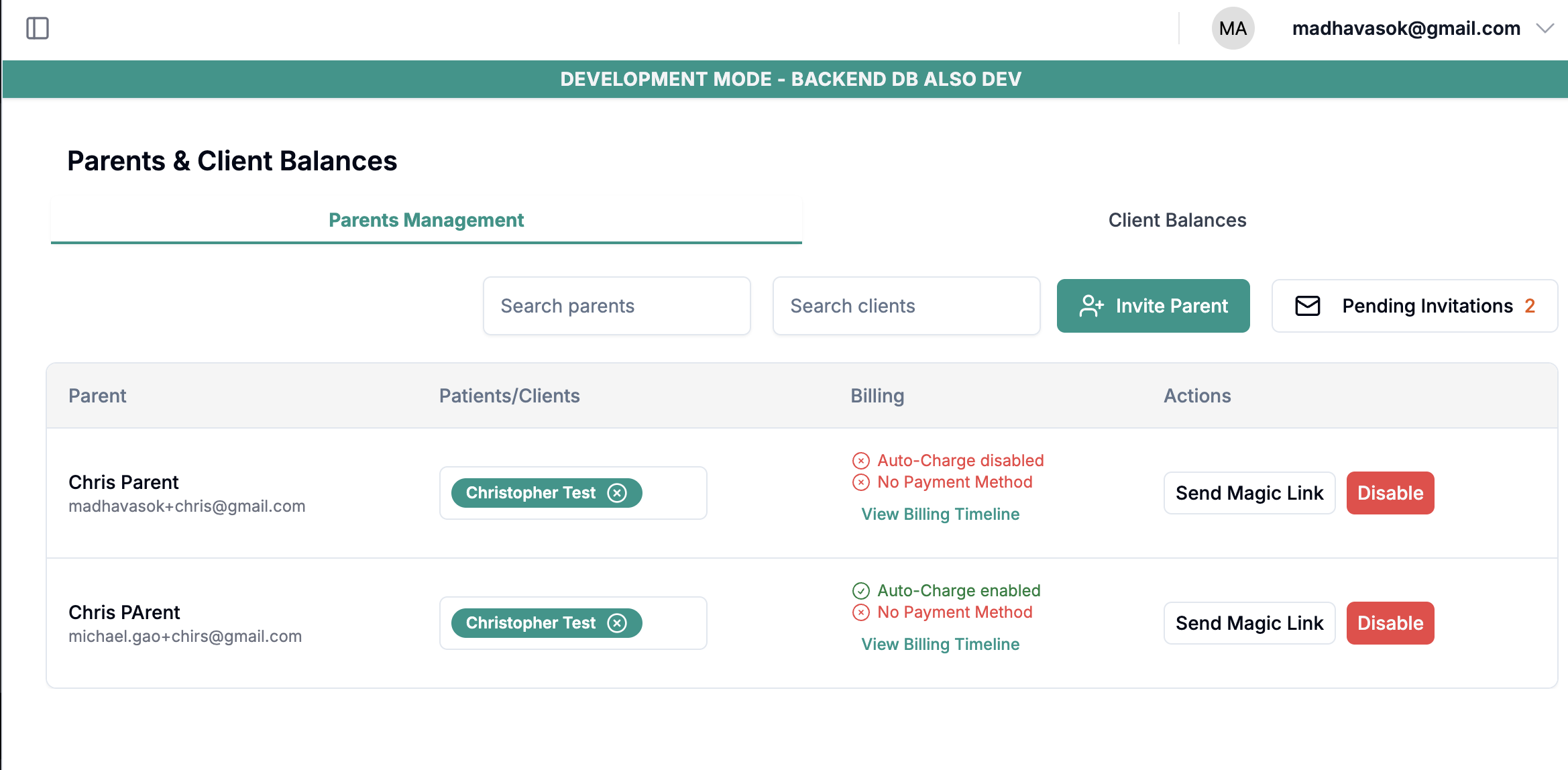
You can see all your parents and the emails they have on the Parents Management tab of Parents.
You can direct parents to secure.alpacahealth.io and log-in with the emails on this menu. If they forget their password, they can click Forget Password on the log-in page.
If they continue to have problems, please have them email Alpaca directly at support@alpacahealth.io
I want to add a new parent.
Sometimes, the parent that fills out an intake form is not the parent who pays the invoices. In this case, parents can either share a log-in, or you can add a new parent with the Invite Parent button.
What do I do if parents have questions about patient responsibility?
If parents have questions about patient responsibility, you can tell them to reach directly out to Alpaca. We are happy to walk families through their benefits.
Key Takeaways for Practice Owners
Collecting patient responsibility is required by payers and is essential for your practice’s financial stability.
Only bill families after receiving the insurer’s finalized EOB.
Hardship waivers are allowed, but only with documented, case-by-case evaluation.
Supporting families through temporary hardship isn’t just compassionate — it improves retention and overall revenue.
A written policy and consistent documentation keep you compliant and protected.