What Happens If You Waive Patient Responsibility
Last updated: July 21, 2026
Evaluating Patient Responsibility Waivers in Financial Models 💰 - Watch Video
Accompanying Financial Spreadsheet Here
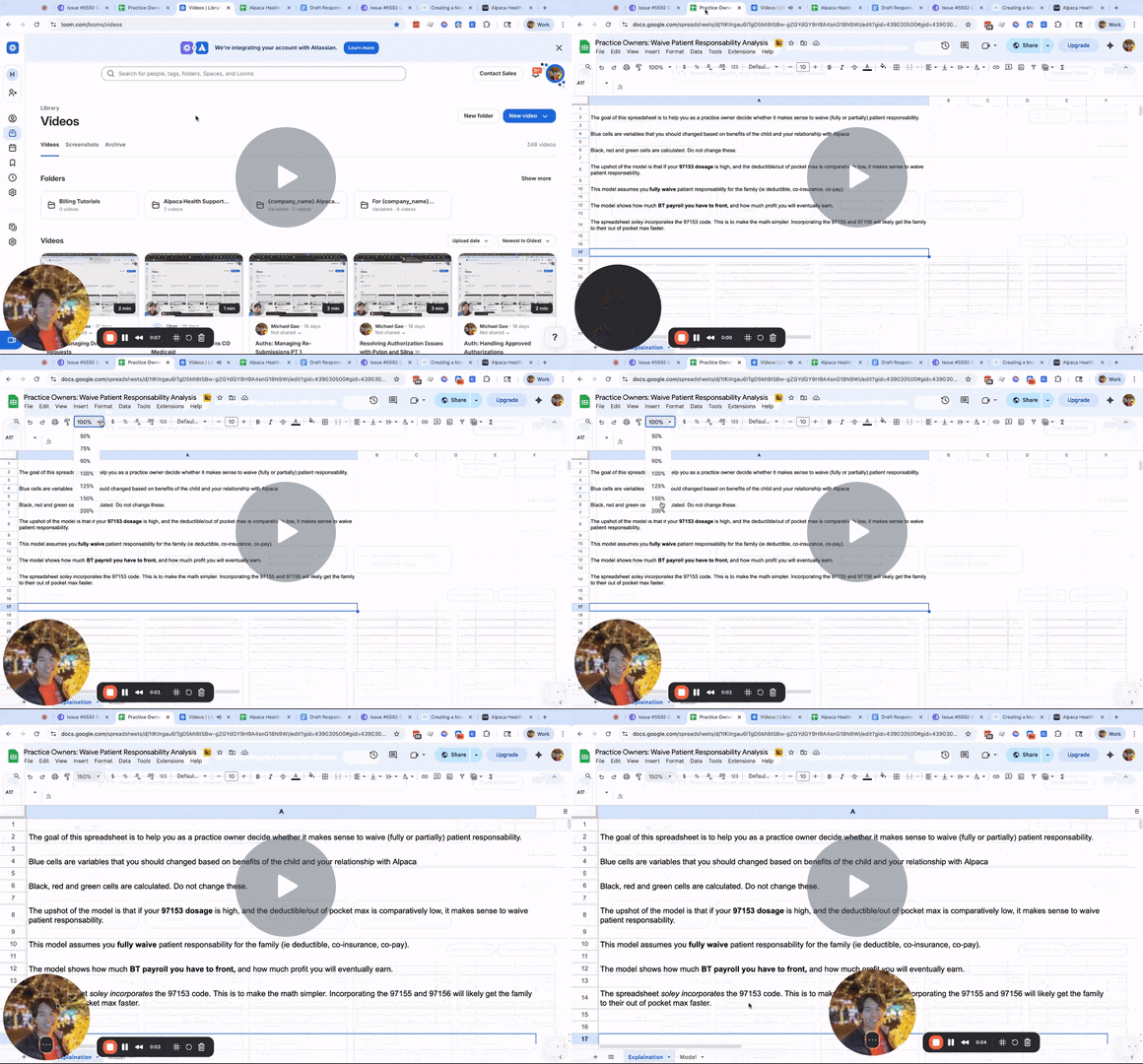
This spreadsheet is designed to help you, as a practice owner, decide whether it makes financial sense to waive patient responsibility either fully or partially for a specific family.
In ABA, patient responsibility during the deductible and coinsurance period can create real access barriers for families. At the same time, fronting payroll without reimbursement creates real cash flow risk for practices. This model exists to help you evaluate those tradeoffs clearly and conservatively.
The goal is not to push you toward waiving patient responsibility. The goal is to give you a structured way to understand:
How much BT payroll you need to front during the deductible and coinsurance period
How long it takes for a family to reach their deductible and out-of-pocket maximum
Whether the case is ultimately profitable over the course of the year
Important Context About Alpaca Payouts
As a reminder, Alpaca guarantees payment of the insurance portion of claims only. Alpaca does not guarantee collection of patient responsibility.
That means:
Practices are not paid by Alpaca until the deductible is met
Practices do not receive the patient responsibility portion unless the family pays it
If patient responsibility is waived, the practice absorbs that cost
This model helps you evaluate whether absorbing that cost is financially viable for a given case.
For additional context, please read this article on our Payouts System and this article on Patient Responsability
How the Spreadsheet Is Structured
Blue cells are inputs. These are the only cells you should change.
Black, green, and red cells are calculations. They show intermediate and final outputs and should not be modified.
You can look “under the hood” to understand the math, but the intent is that you adjust only the blue cells.
What the Model Is Designed to Show
The core insight of the model is simple:
If 97153 dosage is relatively high and the deductible and out-of-pocket maximum are relatively low, it can make financial sense to fully or partially waive patient responsibility.
This is not universally true. In cases with very high out-of-pocket maximums or very low weekly dosage, waiving patient responsibility can result in a loss.
The spreadsheet is designed to surface that distinction clearly.
Guardrails and Clinical Integrity
This model is not intended to influence clinical decision-making.
You should not:
Increase 97153 utilization to make the spreadsheet “work”
Change dosage recommendations for financial reasons
Use this model to justify inappropriate service delivery
Clinical recommendations should always be made independently. This model simply evaluates the financial implications after a clinical plan has already been determined.
Key Assumptions (and How They’re Conservative)
The model intentionally makes conservative assumptions so that, if the case works here, it is likely to perform as well or better in reality.
1. Full Waiver of Patient Responsibility
The model assumes you fully waive:
The deductible
Coinsurance
Copays
until the family reaches their out-of-pocket maximum.
In practice, you may choose to:
Waive only the deductible
Ask families to continue paying coinsurance
Offer partial hardship waivers
If the case is profitable even under a full waiver, partial waivers only improve the economics.
2. 97153 Only
The spreadsheet only models 97153 to simplify the math.
In reality, incorporating:
97155 (BCBA supervision)
97156 (parent training)
will generally move families to their out-of-pocket maximum faster, which improves profitability relative to what the model shows.
What You’ll Input Into the Model
Patient Benefits
You’ll enter:
Remaining deductible
Remaining out-of-pocket maximum
Coinsurance percentage or copay
If a patient has only a flat copay (for example, $30 per visit), the model does not perfectly capture that structure. In those cases, using a small percentage assumption (such as 5%) is reasonable and still conservative. In most copay-only scenarios, waiving patient responsibility is typically easier to justify.
Rate and Utilization Assumptions
You’ll input:
Insurance billed rates
Alpaca payout rates
Expected 97151 units for the assessment
Weekly 97153 units
BT hourly wage (fully loaded with payroll taxes, PTO, and benefits)
It is recommended to err on the high side for BT wages to keep the model conservative.
How to Read the Results
The model walks through three financial phases:
1. Deductible Period
During this phase:
You are delivering services
You are billing insurance
You are not being paid yet
You are fronting BT payroll
This is where short-term losses can occur.
In some cases, this loss can be reduced or eliminated if the BCBA delivers services directly during the deductible period.
2. Coinsurance Period
Once the deductible is met:
Insurance begins paying its share
Patient responsibility still applies
If waived, your effective reimbursement is reduced
This phase may generate small weekly profits, break-even results, or modest losses depending on dosage and rates.
3. Post Out-of-Pocket Maximum
After the out-of-pocket maximum is met:
Insurance pays 100% of allowed amounts
Patient responsibility disappears
You receive full revenue and margin
This phase often drives the majority of annual profitability.
The spreadsheet calculates how many weeks remain in the year and how much time the case spends in each phase.
Interpreting the Bottom Line
The final output shows:
Total payroll you must front
Weekly profit or loss during each phase
Total annual profit or loss for the case
You can then stress-test the model by adjusting:
Out-of-pocket maximum
Weekly 97153 dosage
BT wage assumptions
You’ll quickly see where waivers make sense and where they do not.
How to Use This in Practice
This model is best used when:
A family is concerned about patient responsibility
You already have a clinically appropriate treatment plan
You want to evaluate whether a hardship waiver is financially feasible
It is not a blanket policy tool. It is a case-by-case decision aid.
Final Takeaway
Waiving patient responsibility is not always possible and not always appropriate. But in higher-dosage cases with relatively low deductibles or out-of-pocket maximums, it can be both family-supportive and financially rational.
This spreadsheet gives you a conservative, transparent way to make that decision with confidence.
If you have questions about the model or want help walking through a specific case, reach out to us at support@alpacahealth.io.